
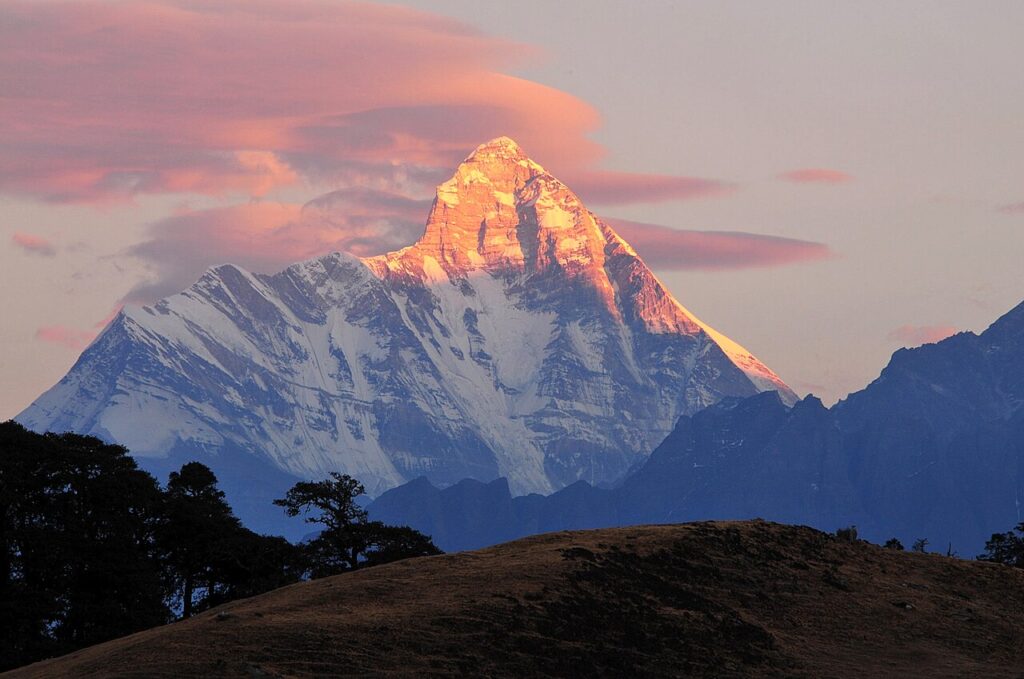
Most religious processions have a fixed annual rhythm — the same date, the same route, year after year. The Nanda Devi Raj Jat breaks that pattern entirely. It happens once every twelve years, sometimes with even longer gaps, and when it does happen, it involves walking roughly 280 kilometers over three weeks through some of the most physically demanding terrain in the Garhwal Himalayas, at the head of which walks a four-horned ram, understood by pilgrims to be carrying the goddess Nanda Devi back to her husband Shiva's abode in the high mountains. It's one of the longest and most arduous religious processions anywhere in India, and outside Uttarakhand, remarkably few people have heard of it.
Who Nanda Devi Is
Nanda Devi is both a mountain — at 7,816 meters, the second-highest peak entirely within India, sacred and long off-limits to mountaineers under Indian government restrictions protecting it as a biosphere reserve — and a goddess, understood across Garhwal and parts of Kumaon as a form of Parvati, Shiva's consort. Local belief holds that Nanda Devi was born into a Garhwali royal family, specifically associated with the Chand and Panwar-era ruling houses, and married off to Shiva, a marriage that required her to leave her natal home in the hills and travel to her husband's abode.
The Raj Jat reenacts exactly that journey — a symbolic escorting of the goddess, in the form of a specially selected four-horned ram, from what's understood as her parental home back to her husband's mountain domain. It's structured, emotionally, exactly like a bidai — the traditional, often tearful farewell given to a daughter leaving her natal family home after marriage — except stretched across three weeks and 280 kilometers, and undertaken by an entire moving community of thousands rather than a single family.
The Route
The yatra typically begins near Nauti village in Chamoli district and moves through a sequence of towns and villages — Nandkesari, Kansuwa, Wan, and onward — before climbing toward its endpoint at Homkund, a high-altitude lake near the base of Trishul peak, close to the Nanda Devi sanctuary itself. The final, most demanding stretch takes pilgrims across Roopkund — famous in its own right as the "skeleton lake," where hundreds of ancient human remains were discovered frozen into the lake ice, believed by some researchers to belong to pilgrims from a much earlier era who perished in a sudden hailstorm, possibly on an earlier iteration of this very pilgrimage — before the final ascent to Homkund.
The terrain covered ranges from lower Himalayan forest and agricultural village land to genuinely high-altitude alpine terrain above 4,000 meters, exposed ridgelines, and unpredictable weather that can shift from clear skies to snow within hours even during the yatra's typical late-August to early-September timing. Pilgrims walk essentially all of it — this isn't a pilgrimage with much vehicle support once past the initial approach roads, and the final days involve serious high-altitude trekking that would challenge even experienced hikers, let alone the elderly devotees and ordinary villagers who join for at least portions of the route.
The Four-Horned Ram
Central to the entire procession is the selection of a four-horned ram, an animal considered naturally rare and understood as a divine sign when one is found. Locating a genuine four-horned ram — not always a straightforward matter, since the physical trait is uncommon — is treated as an essential precondition for the yatra to proceed at all, and its selection process itself carries ritual weight, drawing on village communities and traditional families associated with the pilgrimage's organization.
The ram walks the entire route unburdened, leading the procession, and is released, according to tradition, at the final high-altitude point near Homkund, left to wander into the wilderness as a symbolic completion of escorting the goddess to her destination — pilgrims do not eat or otherwise dispose of the ram themselves; its release into the mountains marks the ritual's culmination.
A Procession, Not Just a Walk
Beyond the ram, the Raj Jat involves an elaborate procession of palanquins (locally called "doli" or "nishan"), carrying symbolic representations of Nanda Devi and associated deities from villages along the route, each community contributing its own palanquin and joining the moving procession as it passes through their territory. Different villages and families historically hold specific hereditary roles and responsibilities within the yatra's organization — certain families are traditionally responsible for particular ritual duties, certain village groups for carrying specific palanquins, a division of ceremonial labor passed down for generations.
Thousands of pilgrims join at various points, some walking the entire three-week route, many others joining for shorter stretches near their own villages before dropping off as the procession moves beyond their local territory, so the composition of people actually walking shifts considerably day by day, growing and shrinking as it passes through different regions.
Why It's Only Every Twelve Years
There's no single universally agreed reason for the twelve-year interval, though it aligns loosely with broader patterns of twelve-year ritual cycles found elsewhere in Hindu tradition, most famously the Kumbh Mela. Part of the explanation is straightforwardly practical: a pilgrimage this demanding, requiring this much community-wide organization, financial contribution, and physical toll, simply can't be sustained annually. Organizing the palanquins, coordinating dozens of villages, securing a genuine four-horned ram, and mobilizing the logistics needed to support thousands of pilgrims across three weeks of difficult mountain terrain takes years of preparation and community buy-in that wouldn't be realistic on a yearly basis.
The most recent full Raj Jat took place in 2014, drawing considerable attention from media and pilgrims well beyond Uttarakhand's borders, including from Garhwali communities who had migrated to cities and returned specifically for the event. Smaller-scale versions or preparatory rituals sometimes occur in intervening years, but the full 280-kilometer procession with its complete set of palanquins and the four-horned ram remains a once-in-twelve-years event.
What It Means to the People Who Walk It
For Garhwali communities, the Raj Jat isn't primarily a tourist spectacle, even though it's increasingly drawn outside visitors and media coverage in recent decades. It functions as a genuine, community-wide expression of regional and religious identity — a moment when villages that might otherwise have limited contact come together around a shared ritual obligation, when families who've migrated to Dehradun or Delhi or further afield make a point of returning, when the mountain itself, usually approached only by restricted, permit-controlled mountaineering expeditions, becomes something ordinary people can process toward and, in a ritual sense, visit.
The physical difficulty of the pilgrimage is part of its meaning rather than an obstacle to it. Walking 280 kilometers through terrain that climbs above 4,000 meters, in service of escorting a symbolic goddess-ram back to her mountain husband, isn't something undertaken lightly, and the fact that it only happens once every twelve years gives each iteration an intensity and rarity that an annual event couldn't replicate. People who walk it as children remember it well into old age; people who miss it wait more than a decade for the next chance. That kind of scarcity, deliberately or not, has kept the Raj Jat from becoming routine in a way that might have diluted its significance, even as Uttarakhand around it has changed enormously in the decades between each procession.